Food guide
NOVA Food Classification: The 4 Groups Explained, With Examples
Short answer
The NOVA food classification sorts every food into one of four groups by how it is processed, not by its calories or nutrients. Group 1 is unprocessed or minimally processed food, like milk, eggs, oats and plain yogurt. Group 2 is cooking ingredients such as oil, butter, sugar and salt. Group 3 is processed food: a group 1 food with salt, sugar or oil added, like cheese or simple bread. Group 4 is ultra-processed food: industrial formulations with ingredients you would not cook with, often with flavors, colors, sweeteners or emulsifiers. NOVA was created by researchers at the University of São Paulo and first proposed in 2009, and it is the system most nutrition research uses to define ultra-processed food (Monteiro et al., 2018). The quick test is the ingredient list: one typical group 4 ingredient is enough to make a food NOVA 4.
What is the NOVA food classification?
NOVA groups foods "according to the nature, extent and purpose of the industrial processing they undergo", in the words of the team that created it. NOVA is a name, not an acronym, so it does not stand for anything (Monteiro et al., 2018).
The idea came from a team at the University of São Paulo in Brazil and was first proposed in a Public Health Nutrition commentary in 2009. Their argument was that the way food is processed explains a lot of the link between diet and health, and that older food groups miss it. A classic food pyramid puts whole grains and sugared breakfast cereals in the same "cereals" group, and fresh chicken and chicken nuggets in the same "meat" group. NOVA separates them.
Brazil built its official Dietary Guidelines for the Brazilian Population (2014) on NOVA, and most studies on ultra-processed food use it.
The 4 NOVA groups, with examples
- NOVA 1, unprocessed or minimally processed foods. edible parts of plants or animals, changed only by steps like cleaning, drying, grinding, filtering, roasting, boiling, pasteurizing, freezing or non-alcoholic fermentation. Examples: fresh or frozen fruit and vegetables, rice, beans and lentils, plain meat and fish, eggs, pasteurized or powdered milk, oats and flour, unsalted nuts, plain yogurt with no added sugar or sweeteners, tea and coffee.
- NOVA 2, processed culinary ingredients. substances taken from group 1 foods or from nature by pressing, refining, grinding, milling or drying. Examples: vegetable oils, butter, lard, starches, sugar, molasses and salt. You cook with them; you do not eat them on their own.
- NOVA 3, processed foods. group 1 foods with salt, oil, sugar or other group 2 items added, then canned, bottled, cooked or fermented. Most have two or three ingredients and still look like the food they came from. Examples: canned vegetables and fish, fruit in syrup, salted or sugared nuts, cured meats, cheese, and bread made only from flour, water, salt and yeast.
- NOVA 4, ultra-processed foods. not modified foods but formulations made mostly from substances derived from foods plus additives, with little or no whole food left. Examples from the NOVA authors: soft drinks, sweet or savory packaged snacks, candy and chocolate, ice cream, mass-produced packaged breads, cookies and cakes, breakfast cereals and cereal or energy bars, margarine, processed cheese, energy drinks, sugared fruit yogurts, instant sauces, nuggets and other reconstituted meat products.
The groups say how a food is made, not whether it is healthy. Sugar is NOVA 2 and salted peanuts are NOVA 3, but neither is ultra-processed. A high-protein, low-sugar bar can still be NOVA 4.
How to tell which NOVA group a food is in
Read the ingredient list, not the front of the pack. A food is NOVA 4 if the list contains at least one item that is typical of ultra-processed food (Monteiro et al., 2019). Those items fall into two kinds.
- Ingredients you would not find in a kitchen. casein, lactose, whey and gluten, and further-processed ones such as hydrogenated or interesterified oils, hydrolyzed proteins, soy protein isolate, maltodextrin, invert sugar and high-fructose corn syrup.
- Cosmetic additives, used to make food look, taste or feel a certain way. colors and color stabilizers, flavors, flavor enhancers, non-sugar sweeteners, and processing aids like emulsifiers, bulking, anti-caking, glazing and carbonating agents.
- What does not count on its own. salt, sugar, oil, butter, preservatives and antioxidants. Those also appear in NOVA 3 foods.
If none of those are on the list, check whether the food is a whole food with nothing added (NOVA 1) or a whole food with salt, sugar or oil added (NOVA 3). A bread made from flour, water, salt and yeast is NOVA 3. The same bread with an emulsifier or a color is NOVA 4.
NOVA groups on real products
These are products we have scored, from the same kinds of shelves. The Truvi score (our method) is an opinion from the label that blends processing with nutrition, so two foods in the same NOVA group can score very differently.
NOVA 1, minimally processed:
-

94Excellent
- Chobani Plain Non-Fat Greek Yogurt scores 94 out of 100. One ingredient. cultured nonfat milk. Non-alcoholic fermentation is a group 1 step, and plain yogurt with no added sugar or sweeteners is one of the NOVA authors' own group 1 examples.
NOVA 3, processed:
-

67Good
-

63Good
- Triscuit Hint of Salt scores 67 out of 100. Three ingredients. whole grain wheat, canola oil and sea salt. A grain with oil and salt added is a textbook NOVA 3 food.
- Mary's Gone Crackers Original scores 63 out of 100. Six ingredients. brown rice, quinoa, flax seeds, sesame seeds, tamari and sea salt. None of them is a group 4 marker; tamari and sea salt are what put it in NOVA 3 on our method rather than NOVA 1.
NOVA 4, ultra-processed:
-

23Bad
-

21Bad
-

18Bad
- Nature Valley Crunchy Oats 'n Honey scores 23 out of 100. Whole grain oats come first, but soy lecithin (an emulsifier) and natural flavor make it NOVA 4. Cereal and energy bars are on the NOVA authors' group 4 list.
- Goldfish Cheddar scores 21 out of 100. The cheddar is colored with annatto, and the list includes autolyzed yeast extract, a flavor ingredient.
- Ritz Original scores 18 out of 100. Its list has high-fructose corn syrup, soy lecithin and natural flavor, three separate group 4 markers.
Notice that the Nature Valley bar and the Ritz cracker start with the same kinds of ingredients as their NOVA 3 neighbors: a grain, oil, sugar or salt. It only takes one or two additives at the end of the list to change the group.
Processed vs ultra-processed foods: the difference
Processed food (NOVA 3) is still recognizably the food it was made from. Cheese is milk with salt and cultures; canned tuna is tuna with oil or water and salt. The processing is there to make the food keep longer or taste better.
Ultra-processed food (NOVA 4) is built from parts of foods and additives, through steps with no home kitchen equivalent, such as hydrogenation, hydrolysis, extrusion and molding. The NOVA authors describe the purpose as making branded, convenient, ready-to-eat products that are very palatable and keep for a long time.
That difference matters in research. A 2024 umbrella review in the BMJ pooled 45 meta-analyses covering about 9.9 million people. Higher intake of ultra-processed food, defined by NOVA, was linked to higher risk of cardiovascular disease deaths, type 2 diabetes, anxiety and common mental disorders, with convincing evidence for those links (Lane et al., 2024). The studies were observational, so they show associations, not proof of cause, and much of the evidence was rated low or very low quality.
How to use NOVA when you shop
- Compare within the shelf. crackers, yogurt, bread and bars all come in NOVA 1 or 3 versions and NOVA 4 versions, often side by side.
- Start at the end of the ingredient list. flavors, lecithin and sweeteners usually sit at the end, after the ingredients you recognize.
- Plain beats flavored. plain yogurt is NOVA 1, while sugared fruit yogurts are NOVA 4. Flavors and sweeteners are what move a food into group 4.
- Ignore front-of-pack words. "natural", "whole grain", "organic" and "high protein" say nothing about the NOVA group.
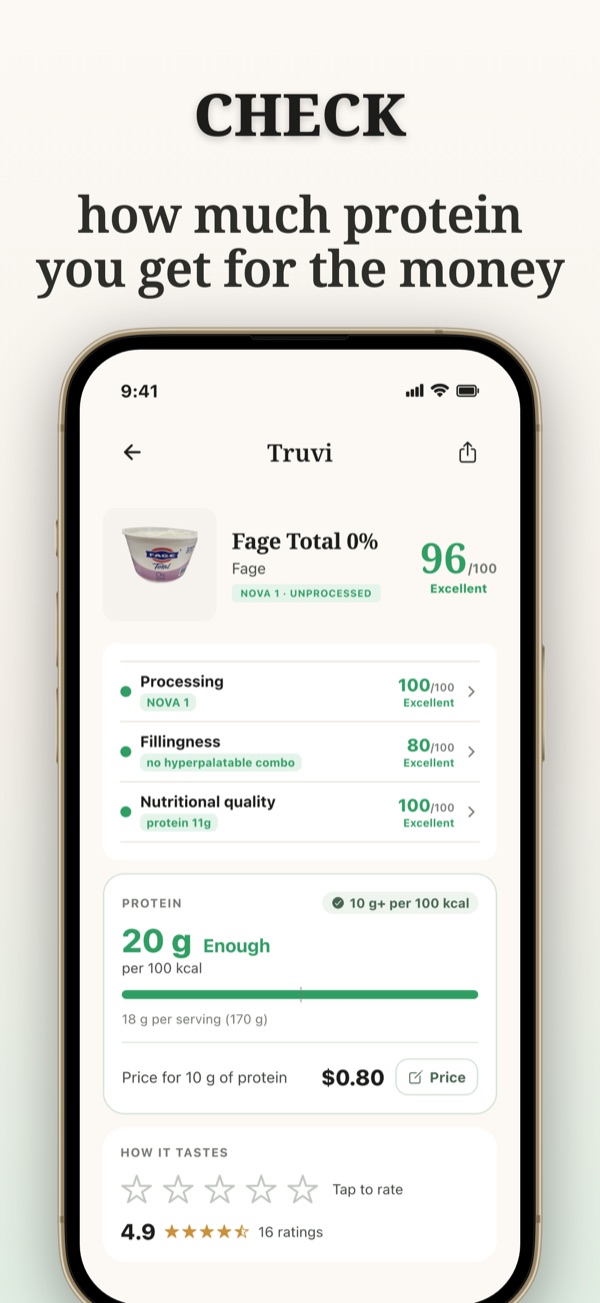
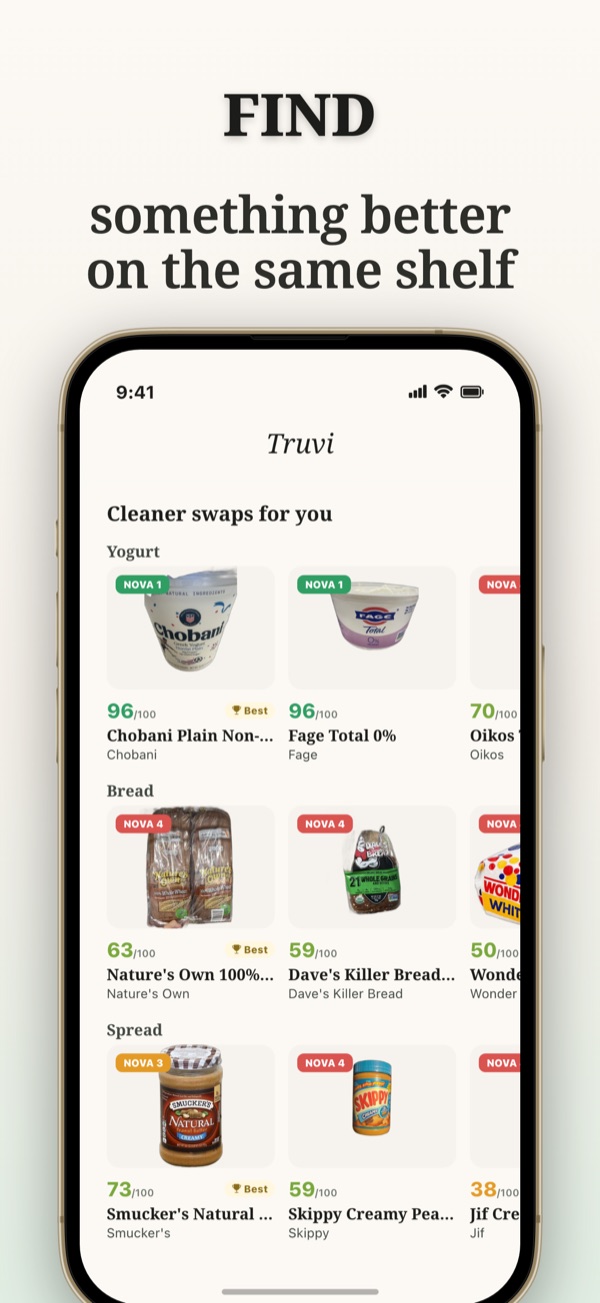
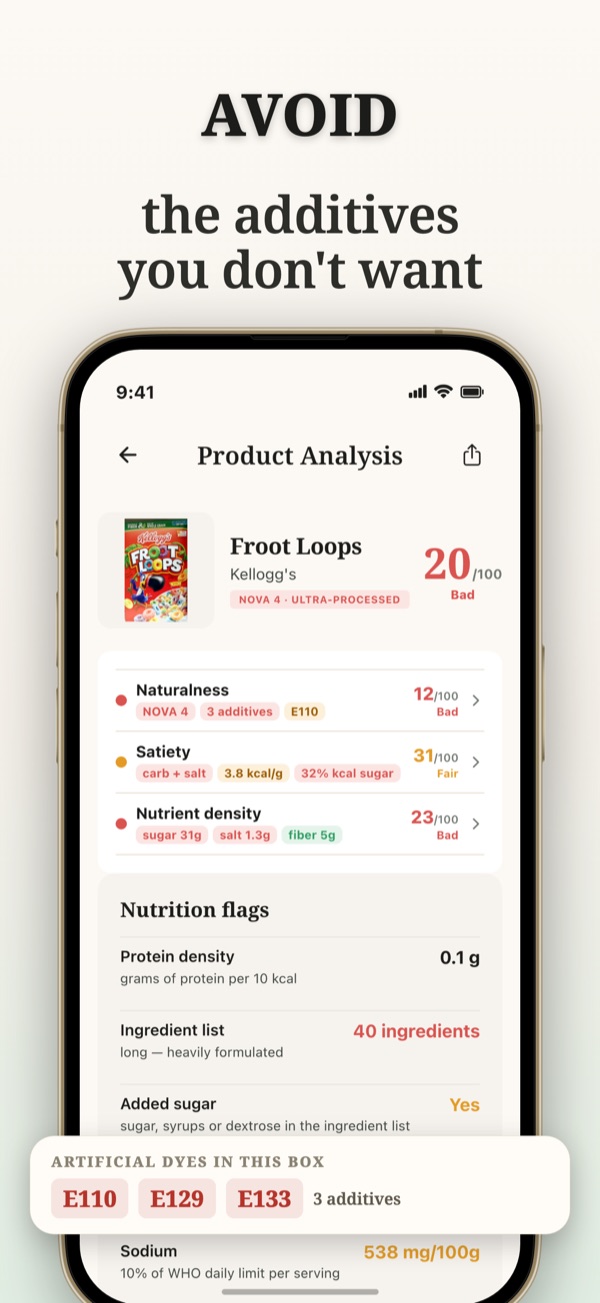
Truvi does the check for you. Scan a barcode and the app shows the NOVA group, the ingredients that put the food there, its Truvi score out of 100, and a better-scoring option from the same shelf.
Questions people ask
What is the NOVA food classification system?
A way of sorting food into four groups by how it is processed: unprocessed or minimally processed foods (NOVA 1), processed culinary ingredients (NOVA 2), processed foods (NOVA 3) and ultra-processed foods (NOVA 4). It was developed by researchers at the University of São Paulo and is the definition most ultra-processed food research uses.
What does NOVA stand for?
Nothing. Its creators describe NOVA as a name, not an acronym.
What are the 4 NOVA groups?
Group 1: unprocessed or minimally processed foods, like fruit, eggs, milk and plain yogurt. Group 2: culinary ingredients, like oil, butter, sugar and salt. Group 3: processed foods, like cheese, canned fish and simple bread. Group 4: ultra-processed foods, like soft drinks, packaged snacks, most breakfast cereals and most bars.
What is the NOVA classification of ultra-processed foods?
Ultra-processed foods are NOVA group 4. A food belongs there if its ingredient list has at least one item typical of industrial formulation, such as protein isolates, high-fructose corn syrup, hydrogenated oils, flavors, colors, non-sugar sweeteners or emulsifiers.
What is the difference between processed and ultra-processed foods?
Processed foods (NOVA 3) are whole foods with salt, sugar or oil added, and most have two or three ingredients, like Triscuit Hint of Salt. Ultra-processed foods (NOVA 4) contain industrial ingredients or cosmetic additives, like the high-fructose corn syrup, soy lecithin and natural flavor in Ritz crackers.
Is yogurt ultra-processed under NOVA?
Plain yogurt with no added sugar or sweeteners is NOVA 1, minimally processed. Sugared fruit yogurts are listed by the NOVA authors as ultra-processed (NOVA 4), because of the sugar and the flavors or sweeteners that come with it.
Is there an app that shows the NOVA classification?
Yes. Truvi shows the NOVA group when you scan a barcode, along with the ingredients that decided it, a Truvi score out of 100 and a better option from the same shelf.
Sources
- Monteiro CA et al. The UN Decade of Nutrition, the NOVA food classification and the trouble with ultra-processing. Public Health Nutrition, 2018.
- Monteiro CA et al. Ultra-processed foods: what they are and how to identify them. Public Health Nutrition, 2019.
- Lane MM et al. Ultra-processed food exposure and adverse health outcomes: umbrella review of epidemiological meta-analyses. BMJ, 2024.
Product scores are the Truvi score (our method, from the label). How the score works. Not medical advice.
Spotted a mistake? Email [email protected] and we will review it.
Check any product before you buy it
Point your phone at a barcode in the store. Truvi shows the score, what's inside and a better option on the same shelf.
Download on theApp Store